
EXACT Sports
Game Day Nerves: The Science of Staying Locked In When It Matters Most
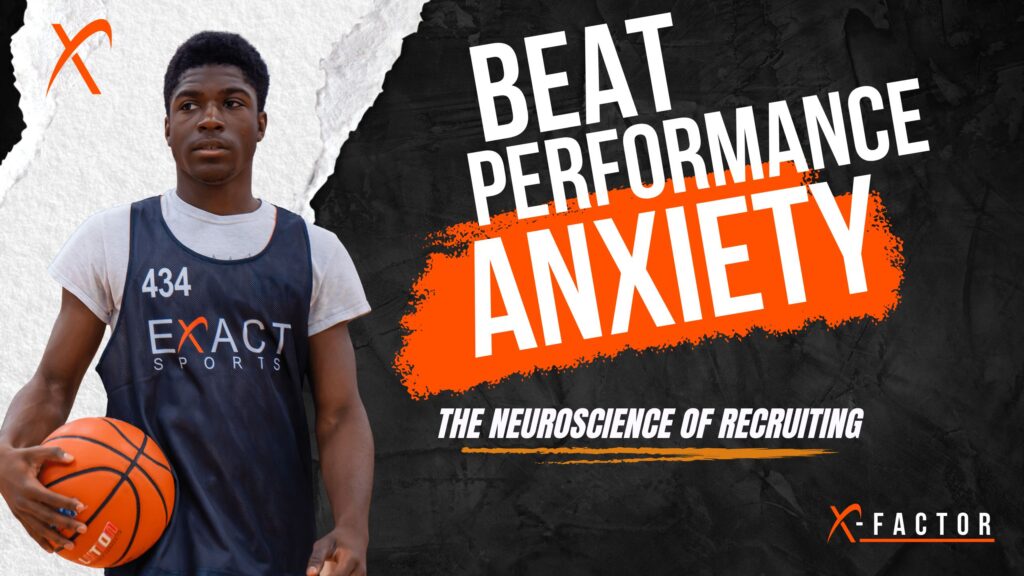
Game day.
You’ve trained for weeks. Maybe months. Maybe years. But when the whistle blows, your heart is pounding, your hands feel tight, and your mind is racing.
If you’re an athlete chasing the next level — or a parent watching your child battle nerves before competition — you’ve probably wondered:
“Why can’t they just calm down?”
On this episode of the X-Factor Podcast, EXACT Sports founder Barry Tarter sits down with our Director of Research, Dr. Ralph Tarter, to unpack what’s actually happening in the brain during high-pressure moments — and how athletes can build real, science-based mental toughness.
Dr. Tarter is a clinical psychologist whose decades of NIH-funded research tracked adolescents from childhood into adulthood, studying brain development, emotional regulation, and performance under stress. What he shares in this episode reframes everything most families believe about “just relaxing.”
Because here’s the truth:
You can’t out-talk biology.
But you can train it.
Top 3 Lessons from This Episode
- You can’t “calm down” on command. Game day nerves are a biological survival response — not a mindset flaw.
- Mental toughness isn’t hype — it’s self-regulation. The best athletes train their brain to manage stress through preparation and automaticity.
- Confidence comes from rehearsal, not pep talks. Mental rehearsal + physical reps create the neural pathways that hold up under pressure.
The Character: The Athlete Who Wants to Show Up Big
You want to play your best when it matters.
Maybe you’re trying to:
- Make varsity
- Earn a starting role
- Get recruited
- Perform in front of scouts
- Help your team win a championship
Or maybe you’re a parent who simply wants your athlete to feel confident, steady, and in control.
The goal isn’t just talent.
The goal is consistent performance under pressure.
The Problem: The “Fight, Flight, Freeze” Trap
Here’s the villain most families misunderstand:
Game day nerves aren’t weakness. They’re wiring.
Dr. Tarter explains that when an athlete perceives threat — whether it’s physical danger or social evaluation — a deep brain structure called the amygdala activates.
Its job? Survival.
Across species, that survival system produces three responses:
- Fight (aggression)
- Flight (avoidance)
- Freeze (shutdown)
None of these are ideal for running a route, taking a penalty kick, or defending a fast break.
And here’s the kicker:
You cannot override this system with slogans like:
- “Calm down.”
- “It’s no big deal.”
- “Just relax.”
The body knows.
In fact, research on skydivers shows stress markers like cortisol rise days before the jump — even when participants say they feel fine. The same buildup happens before big games, playoff matches, and showcase events.
So the real problem isn’t nerves.
The problem is lack of training for managing nerves.
The Guide: EXACT’s Evidence-Based Approach
At EXACT Sports, our mental performance system wasn’t built on clichés.
It was built on:
- Decades of NIH-funded developmental research
- Brain-behavior science
- Longitudinal tracking of youth performance outcomes
- Thousands of athlete evaluations
- Real-world experience with NHL, MLB, and college programs
Dr. Tarter’s work focused on how adolescents develop self-regulation — the ability to align emotions and behavior with the demands of a situation.
And that’s what “mental toughness” really is.
Not bravado.
Not yelling louder.
Not pretending you’re not nervous.
It’s self-regulation under stress.
What’s Actually Happening in the Brain?
When the amygdala fires (the stress signal), it sends activation signals throughout the brain:
- Downward → activating physiological arousal (heart rate, adrenaline)
- Forward → toward the prefrontal cortex, responsible for executive function
The prefrontal cortex is the part of the brain that:
- Evaluates situations
- Regulates emotion
- Maintains focus
- Controls impulses
- Executes strategy
When it’s online and trained, athletes can:
- Recover quickly from mistakes
- Avoid emotional penalties
- Stay task-focused
- Adapt in real time
When it’s overwhelmed?
You see:
- Dumb fouls
- Emotional outbursts
- Lingering mistakes
- Performance spirals
So the real question becomes:
How do we strengthen the prefrontal system so it can regulate the stress response?
The Plan: A 3-Step Mental Performance System
Here’s the practical roadmap athletes and families can follow.
Step 1: Build Automaticity Through Repetition
Dr. Tarter uses a powerful analogy:
Remember learning to drive?
At first, everything required conscious effort:
- Where’s the brake?
- How hard do I press?
- When do I signal?
Now? It’s automatic.
Elite performance works the same way.
Through:
- Repeated physical practice
- Scenario-based reps
- Film review
- Correction and feedback
Skills move from conscious processing → automatic execution.
Why does this matter?
Because when stress rises, cognitive bandwidth shrinks.
Automatic skills survive.
Untrained skills collapse.
Pro Tip: Game film is gold. Watching mistakes and correcting them builds neural refinement that holds under pressure.
Step 2: Mental Rehearsal Before the Event
Stress builds before competition.
That’s normal.
The key is channeling that buildup productively.
Athletes should mentally rehearse:
- Specific play scenarios
- Their positional responsibilities
- “What if” situations
- Recovery from mistakes
Instead of saying:
“I hope I don’t mess up.”
Shift to:
“If X happens, here’s my response.”
This builds:
- Confidence
- Predictability
- Faster reaction times
- Reduced distraction
Mental rehearsal reduces the novelty of pressure.
And novelty fuels anxiety.
Step 3: Focus on Task, Not Emotion (In-Game Reset)
During the game, one rule dominates:
Return to task.
Not:
- “Why did I miss that?”
- “Coach is mad.”
- “Everyone saw that mistake.”
But:
- “What’s my assignment right now?”
Dr. Tarter emphasizes:
The best athletes recover quickly from error.
If a goalie gives up a goal…
If a DB gets burned…
If a shooter misses a clutch attempt…
The difference-maker isn’t perfection.
It’s speed of emotional recovery.
The longer emotion lingers, the more it compounds.
The faster attention returns to task, the more stable performance becomes.
Tactical Tools We Teach at EXACT Events
Here are two quick tools we implement with athletes:
1. Breathing Consistency
Game-day breathing should match practice breathing.
Short, shallow breaths increase arousal.
Controlled diaphragmatic breathing stabilizes it.
Practice breathing regulation during training — not just competition.
Consistency builds familiarity.
Familiarity reduces spike response.
2. Reframing “Nervous” as “Excited”
Physiologically, nervousness and excitement look almost identical.
The difference? Interpretation.
Instead of:
“I’m nervous.”
Try:
“I’m activated and ready.”
With repetition and exposure, arousal becomes normalized.
And normalization builds confidence.
The Stakes: What Happens If You Ignore This?
If athletes rely only on hype and motivation:
- Stress spikes remain unmanaged
- Errors linger
- Confidence becomes fragile
- Emotional penalties increase
- Performance becomes inconsistent
Over time, unmanaged stress can push athletes toward unhealthy coping strategies — something Dr. Tarter has studied extensively in adolescent development.
But when athletes develop agency — a sense of personal control over their preparation and response — everything changes.
They gain:
- Emotional stability
- Faster recovery
- Sustainable confidence
- Resilience after failure
- Long-term developmental growth
And that confidence transfers beyond sport — into academics, leadership, and life.
The Symphony Analogy: Why Teams Must Sync
Dr. Tarter compares a team to a symphony orchestra.
Each musician:
- Has a specific task
- Must rehearse independently
- Must perform collectively
- Must recover quickly from mistakes
Game day is the concert.
Practice is rehearsal.
The audience? They’re watching either way.
The athlete who thrives is the one who has:
- Practiced physically
- Rehearsed mentally
- Built automaticity
- Accepted that failure will happen
- Trained recovery speed
Even legends miss shots.
The difference is they don’t let misses define the next play.
The Bottom Line
Mental toughness isn’t loud.
It isn’t chest-pounding.
It isn’t pretending fear doesn’t exist.
It’s:
- Self-regulation
- Automatic skill execution
- Task-focused attention
- Fast recovery
- Rehearsed confidence
Game day nerves are not the enemy.
Untrained responses are.
When athletes understand the science — and train accordingly — they don’t eliminate nerves.
They harness them.
And that’s the real X-Factor.
Table of Contents
ToggleOur Author
Shannon Sitch
Senior Coach Recruiter
Shannon Sitch brings the competitive edge of a National Champion to the recruiting process. With 13 years of experience as a college coach (DII and DIII) and a pedigree that includes winning a DII National Title as a player at the University of Tampa, Shannon knows what wins. Her background as an ODP and club coach for over a decade allows her to translate complex NCAA expectations into actionable advice for youth players. Shannon provides the “coach’s eye” view, helping athletes understand exactly what college programs are looking for in a recruit.

EXACT Sports is proudly powered by WordPress